Romanesque Revival (Annex Style)
Strength, permanence, and sculptural masonry
Emerging in Toronto in the late 1880s and remaining influential into the early 20th century, Romanesque Revival — often referred to locally as the “Annex Style” — introduced a bold and weighty architectural presence to the city’s residential streets. In its most robust civic expressions, such as Queen’s Park and Old City Hall, the style was inspired by the work of American architect Henry Hobson Richardson, whose designs emphasized mass, texture, and powerful masonry forms.
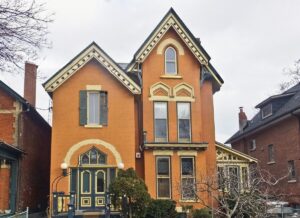
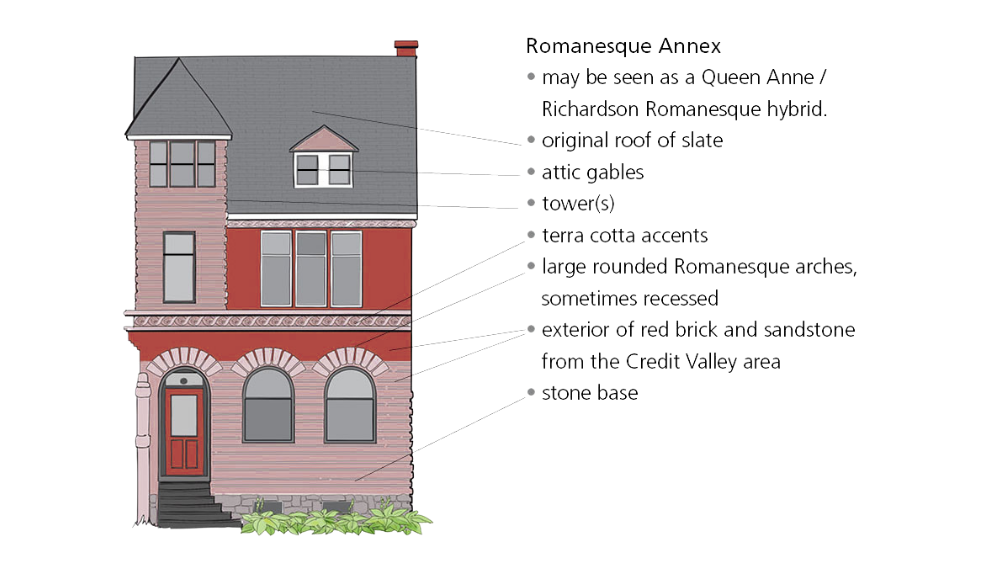
In residential adaptations, the style retained its hallmark features: broad rounded arches, deeply recessed openings, heavy stone or brick façades, and richly textured surfaces. Unlike the vertical delicacy of Queen Anne or Bay-and-Gable homes, Romanesque Revival conveyed solidity and permanence. Thick masonry walls, pronounced voussoirs framing arched windows, and asymmetrical compositions gave these houses a sculptural quality that distinguished them from lighter Victorian forms.
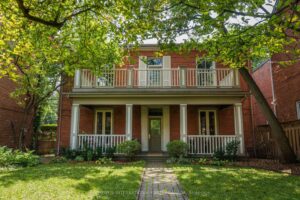
In Cabbagetown, Romanesque Revival appears in a refined and often smaller-scale interpretation, yet it maintains its commanding architectural presence. Rows such as 93 to 99 Winchester Street demonstrate the style’s defining arched openings and masonry articulation — notably enhanced by McCausland stained glass set within their dramatic arches. These details reveal the craftsmanship and artistic ambition that characterized the period.
The former St. Enoch’s Church at 80 Winchester Street provides a more monumental example of the style’s ecclesiastical expression, where heavy stonework and rounded arches reinforce the architectural language of strength and endurance.
While Romanesque Revival is found elsewhere in Toronto, its presence within Cabbagetown contributes to the remarkable architectural diversity of the district. It represents a moment when homeowners and institutions alike embraced a style that projected stability, cultural aspiration, and architectural sophistication.
Together with the surrounding Victorian forms, Romanesque Revival buildings enrich the layered architectural character that makes Cabbagetown such an exceptional and historically cohesive neighbourhood.