When is a Heritage Permit required? How do I obtain one?
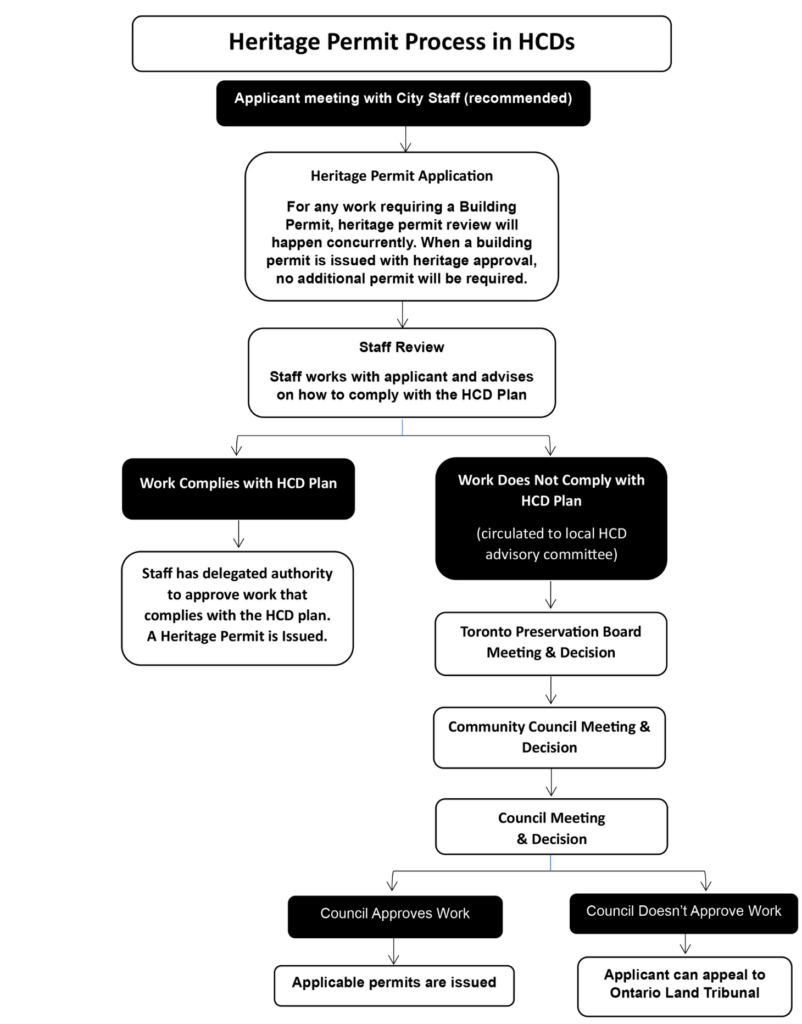
- Certain types of alterations or renovations to a property within an HCD will require a heritage permit. Staff have delegated authority to approve most permits if they comply with the HCD policies and the Official Plan.
- The HCD Plan will explain when a heritage permit is required. Some examples include:
- repairing or replacing windows and doors
- Adding an addition to your property
- Replacing a porch or any of its components
- Demolition of any part of the building
- Property owners are encouraged to consult with Heritage Planning staff prior to starting work.
- A heritage permit is not required if an alteration or renovation is not visible from the street, or if it only affects the interior of a building.
- Routine maintenance activities do not require a heritage permit. Examples include:
- Painting (unless over brick)
- Installation of eaves troughs
- Exterior lighting
- Weatherproofing
Applying for a Heritage Permit
- Please visit the Heritage Permit Guide on the city’s website, and review the list of required materials to submit.
- Prepare drawings, sketches or plans of the proposed work.
- Take photographs of the building, showing its current condition in the area where the work is to take place.
- Email the required information to the following City of Toronto Heritage Preservation staff member:
Jennifer Guerin / Jennifer.Guerin@toronto.ca / 416-338-9458 - Staff will contact you if anything is missing, and the Heritage Planner will work with you to ensure compliance and to complete the process.
If City staff determines the application conforms to the guidelines within the community’s HCD Official Plan, they will expedite the necessary Heritage Permit and Building Permits. If the application does not meet the guidelines, City staff will suggest ways to modify the project in order to secure the required Heritage Permit.
The purpose of an HCD is not to prevent change. HCD policies and guidelines ensure that future changes complement, rather than detract from, the district’s unique character.
Need Further Assistance?
Community advice on navigating the Heritage Permit process is available through the Cabbagetown HCD Advisory Committee, whose members are knowledgeable about the area’s history and architecture. The Advisory Committee is familiar with each Cabbagetown HCD and their respective official plans. The committee does not enforce the community’s heritage status guidelines; enforcement is a city and provincial function.
To contact the Cabbagetown Heritage Conservation Advisory Committee, please email:
info@cabbagetownhcd.ca
Permit Process FAQ
Is there a cost for heritage permit applications, and how long is the application process?
- There is no cost to apply for a standalone heritage permit.
- Heritage permit applications can be approved within a week.
- Complicated applications that involve extensive alterations can take longer.
- Certain alteration or renovation projects may also require a building permit and there may be fees connected to the building permit application.
- A heritage permit does not replace a building permit. If your project also requires a building permit, the two permit systems are assessed and issued together.
A Building Permit and certain other City approvals will not be issued for a property that is designated under the Ontario Heritage Act until the applicant has received a heritage permit. Property owners are encouraged to speak to Heritage Planning staff prior to applying for other Planning and Building permissions including Minor Variances, Zoning By-Law Amendments and Building Permits, since Heritage Planning is part of the approval process and can offer guidance.
Is there a Heritage Conservation District Advisory Committee for my HCD? What do they do?
The Cabbagetown Heritage Conservation Advisory Committee is a volunteer board that can assist homeowners in navigating the HCD guidelines and official plan. The Committee also maintains this helpful website with up-to-date news and information.
To contact the Cabbagetown Heritage Conservation Advisory Committee, please email:
info@cabbagetownhcd.ca
Roles of the Heritage Conservation Advisory Committee:
- Heritage Conservation Advisory Committees are meant to be ambassadors for the area’s HCD Plan(s) and designation.
- The committee can assist property owners seeking information on heritage matters related to the HCD Plan and the Ontario Heritage Act.
- The Committee is an advisory group and does not possess approval authority but can be a great first point of contact.
- From time to time, Heritage Planning staff may request feedback or comments on heritage permit applications, and the committee may bring questions relating to heritage preservation in the HCD to the attention of staff.
Will being part of an HCD affect my ability to change the use of my property?
- No, Part V designation does not affect the use of a property.
- If an owner would like to change (rezone) the use of a property, an application is required under the Planning Act.
- If a change of use would involve alterations to the exterior of the building, it may require a heritage permit.
Will being part of an HCD affect my property values?
- Property values depend on many complex factors. The Municipal Property Assessment Corporation (MPAC) does not use HCD status as a determining factor for current value assessment.
- Property owners are encouraged to seek advice from real estate agents who have experience with properties in HCDs.
Will being part of an HCD affect my insurance premiums?
- Insurance premiums should not increase because of heritage designation in Ontario. Both the Ministry of Citizenship and Multiculturalism and the Insurance Bureau of Canada have confirmed this.
- Heritage property owners are encouraged to shop around to find the right insurance provider and contact the Insurance Bureau of Canada if their insurer has questions about designation. ibc.ca
- For additional information, see the city’s website: Insuring Your Heritage Home.
Are there Financial Incentives for Heritage Properties?
- Yes, the City of Toronto has two financial incentive programs for heritage properties: the Heritage Grant Program, and the Heritage Property Tax Rebate program. Both programs provide property owners with financial assistance to repair and retain heritage attributes on their property.
- The Heritage Grant program is for heritage properties with residential, or non-profit uses.
- The Heritage Property Tax Rebate (HPTR) program is for heritage properties with commercial, or industrial uses.
- Within an HCD, only contributing properties are eligible for funding.
- Information on the Heritage Grant Program: https://www.toronto.ca/city-government/planning-development/heritage-preservation/tax-rebates-grants/heritage-grant-program/
“Contributing” versus “Non-contributing” properties within an HCD: what does this mean?
- All properties within the district boundary are designated properties that are protected by, and subject to, the Part V designation by-law under the Ontario Heritage Act.
- In the HCD Plan, all designated properties are evaluated and placed in one of two categories: “contributing,” or “non-contributing.”
- The HCD Plan has different policies and guidelines for contributing and non-contributing properties.
- Contributing properties have heritage attributes that clearly reflect and relate to the history and unique character of a district. The HCD Plan will explain how they support the district’s character and heritage attributes.
- Non-contributing properties may consist of vacant land, or a building that does not clearly support the district’s unique character.
Jennifer Guerin is the Heritage Planner assigned to the Cabbagetown Heritage Conservation Districts. If you have questions or concerns Jennifer can be reached at: 416-338-9458 or Jennifer.guerin@toronto.ca.
Since Heritage Planner assignments change from time to time, you can email heritageplanning@toronto.ca to confirm the planner assigned to your area.
—
Appeals Process:
The City of Toronto is responsible for approving work applications requiring a heritage permit. Applications are reviewed initially by the appointed municipal staff person and/or by the heritage district committee, who will check for compliance with the approved guidelines. If there are any concerns, alternative options can be explored with the owner before the application is referred to council for a decision. Council has 90 days from the date of notice of receipt of the application to either issue the permit, possibly with conditions, or refuse it.
The applicant has the right to appeal to the Ontario Municipal Board if the application is refused or if approved with terms and conditions attached. The decision of the OMB is final. If council does not make a decision within the 90-day period it is deemed to have granted the permit.
Section 69 of the Ontario Heritage Act allows for the imposition of a fine of up to $1million for any person found to illegally demolish a property in a Heritage Conservation District. This amount recognizes that illegal demolition of designated heritage properties is one of the most serious offences under the Act. Since the Ontario Heritage Act was passed in 1974, there have been prosecutions carried out for unauthorized alterations or demolition of designated property.
(Credit: Paul King Education Technical Advisor Heritage & Libraries Branch Ontario Ministry of Culture September 21, 2005)
Financial Assistance:
Financial incentives (such as heritage property tax relief, grants and other programs) exist under certain conditions, such as:
Heritage Grant Program:
The Toronto Heritage Grant Program is administered by the Heritage Preservation Services Unit of the City Planning Division to encourage the conservation of designated heritage properties in the City of Toronto. The Toronto Heritage Grant Program provides grant funds of up to 50% of the estimated cost of eligible heritage conservation work to designated heritage properties.
Owners of a property designated under Parts IV or V of the Ontario Heritage Act may qualify to receive a grant for eligible conservation work in either of the two project categories:
- Residential house form buildings – Up to a maximum grant of $10,000.00 for individual properties.
- Commercial, institutional, multi-residential and industrial form buildings.
More information at: https://www.toronto.ca/city-government/planning-development/heritage-preservation/tax-rebates-grants/heritage-grant-program/
Heritage Property Tax Rebate Program:
The Toronto Heritage Property Tax Rebate Program is administered by the Heritage Preservation Services Unit of the City Planning Division to encourage the conservation of heritage properties in the City of Toronto. All eligible heritage properties may receive a maximum of a 40% property tax rebate on identified heritage portions of the property.
More information at: https://www.toronto.ca/city-government/planning-development/heritage-preservation/tax-rebates-grants/heritage-tax-rebate/